
This video and feature is sponsored by Liqui Moly
There’s a tendency to look at a finished project car and assume the person behind it always knew what they were doing. You see tidy paint, expensive Japanese wheels and a nicely sorted engine bay, and it’s easy to imagine years of mechanical experience sitting behind every nut and bolt.
Aaron’s modified Datsun 240Z proves that isn’t always how these builds happen.
When he bought the car around 2018, he wasn’t an experienced mechanic working his way through another restoration. He barely knew where to begin. What he did have was a love for Z-cars, a willingness to ask questions and enough determination to learn by taking things apart and putting them back together again.
The fact the Datsun was an absolute wreck probably helped. There wasn’t much point being precious about it.
From California wreck to dream Datsun 240Z
Aaron had already owned newer Z-cars, but an early S30 was always the one he really wanted. Eventually, he decided there was little point waiting for the perfect moment and started looking seriously.
This car had only just arrived from California when he found it. Several of the other 240Zs he looked at were similarly rough, but this one at least ran — albeit badly. It smoked heavily, had no usable brakes and looked as though several previous owners had given up on it halfway through various stages of repair.
The body wore a mixture of white, black and rust, with traces of its original brown hidden underneath. Inside, there was barely an interior to speak of. The seats were falling apart, the dash had huge sections missing and everything pointed towards a car that needed far more than a quick tidy-up.
Then there was the bullet hole.
Yes, really. Somewhere during its American life, the Z had acquired a gunshot hole in the engine bay. Aaron eventually cut that section of metal out during the restoration and kept it as a souvenir, which feels appropriate. Some cars arrive with service history. Others arrive with ballistic evidence.
He paid around £8,500 for it, which felt like serious money at the time for something he didn’t yet know how to repair.
So naturally, he took it home and started dismantling it.
Learning how to restore a Datsun 240Z
The first stage was less glamorous than the finished car might suggest. Aaron bought the Datsun as winter was approaching, put it on axle stands and began stripping years of underseal and muck from underneath.
He worked back to bare metal to find out what he was actually dealing with, then did the same throughout the interior. Once the true condition of the shell became obvious, welding was handed over to someone with the right skills before the car came back ready for the next stage.
This was also where one of the most important parts of the whole project happened.
A local independent garage owner named Richard agreed to help Aaron learn. Rather than simply taking the car in and sending him an invoice, he showed him how things worked. Aaron was given access to the garage during the evenings and could work through the car piece by piece, learning the mechanical basics as he went.
It’s difficult to overstate how valuable that sort of experience is. You can watch endless videos about rebuilding old cars, but having someone beside you who can explain why something works — and then make you do the next one yourself — is a completely different education.
The carburettors were a perfect example.
Richard stripped one down with Aaron, showing him what all the springs, passages and components actually did. They rebuilt it together, then Aaron was left to tackle the other one himself. He has rebuilt them several times since.
By that point, the 240Z had stopped being simply a restoration. It had become Aaron’s mechanical apprenticeship.
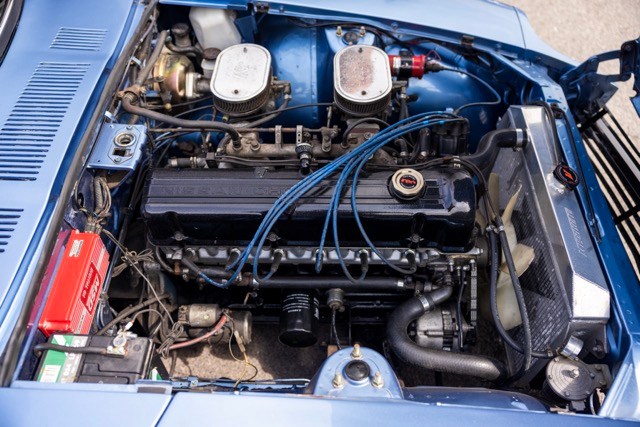
Keeping the original L24 straight-six
Despite the temptation to swap in something bigger or more modern, the car still uses an L24 straight-six, keeping the character that makes an early 240Z feel like a 240Z.
Nissan’s original 240Z was built around the L24 inline-six, and that engine remains one of the defining parts of the early car.
Aaron’s engine has had a rather eventful life, though.
The first rebuild revealed just how unhealthy it had been when he bought the car. The cylinder head was badly warped and there were broken valve guides, among other problems. The engine went away for machining, came back together and allowed Aaron to finally start enjoying the Datsun properly.
Then he took it to Goodwood.
That didn’t go entirely to plan.
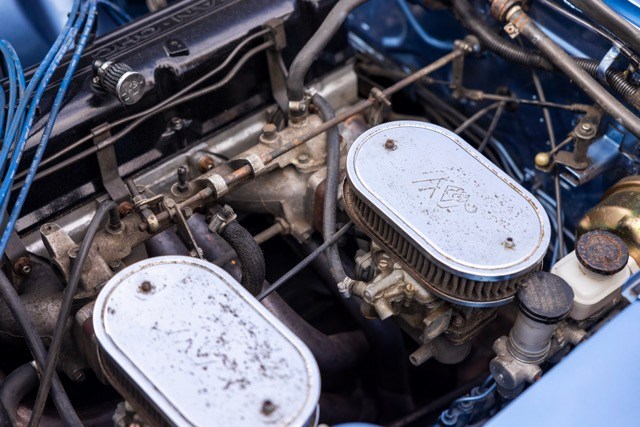
Blowing up a Datsun 240Z at Goodwood
Aaron hadn’t arrived at Goodwood intending to thrash the car around the circuit. He was there for a day out, dog in tow, when a conversation with the track-day organiser unexpectedly ended with an invitation to take the Datsun out.
The original plan was to be sensible.
That lasted about as long as you’d expect.
With an old circuit, an old sports car and an empty track ahead of him, Aaron started leaning on it harder and harder. A few laps later, oil starvation caused a bearing failure and the engine was finished.
Strangely, he remembers it as one of the best days he has ever had with the car.
That says quite a lot about the way Aaron approaches the 240Z. This isn’t a perfect object that exists to be protected from life. He built it to use, and if something breaks as a result, the answer is to understand why and build it better.
The second rebuild required another crankshaft, while the sump was baffled to reduce the risk of the same oil-starvation problem happening again.
And if anything, the engine failure simply became another chapter in the education.
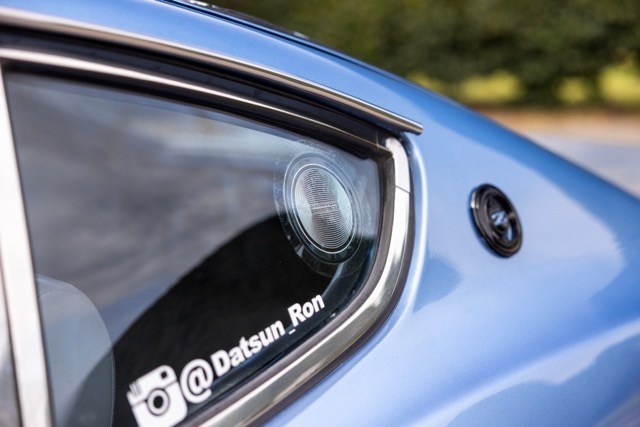
Japanese inspiration shapes the exterior
Once the shell was solid and the mechanical side was coming together, attention turned to how the car should look.
Aaron didn’t want a stock restoration. His inspiration came from two very different approaches to modified Zs, one from America and the other directly from Japan.
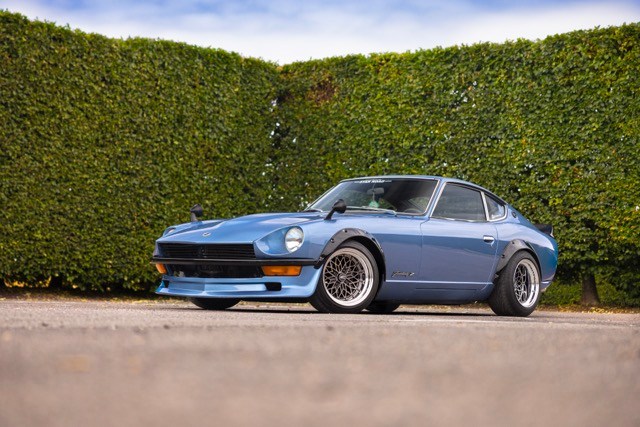
One influence was the Gas Monkey Garage Z, whose muted green paint helped shape the colour direction. Aaron liked that silvery tone but wanted his own version in blue. The finished colour has that same slightly subdued quality, working brilliantly with the old body shape without looking like an obvious factory shade.
The other major influence was Star Road in Japan.
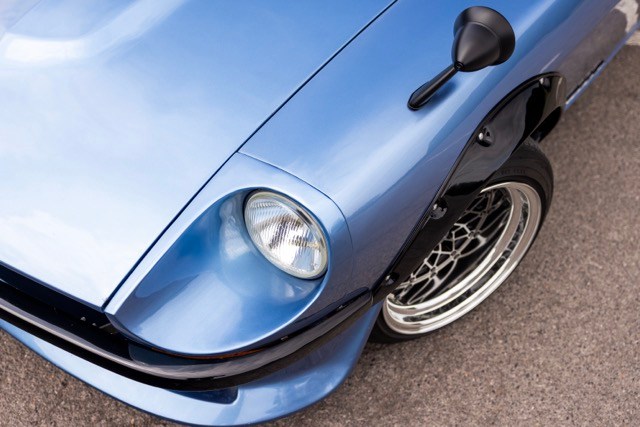
That connection is important because the bolt-on arches aren’t simply generic widebody parts fitted to chase a trend. The Japanese-market 240ZG genuinely used factory overfenders as part of its distinctive body package, alongside the famous G-nose.
Aaron liked that visual language and wanted to take his own car in a similar direction, so cutting the standard arches didn’t bother him. The car was being built for him, not for the approval of people who believed every surviving S30 needed to remain factory standard.
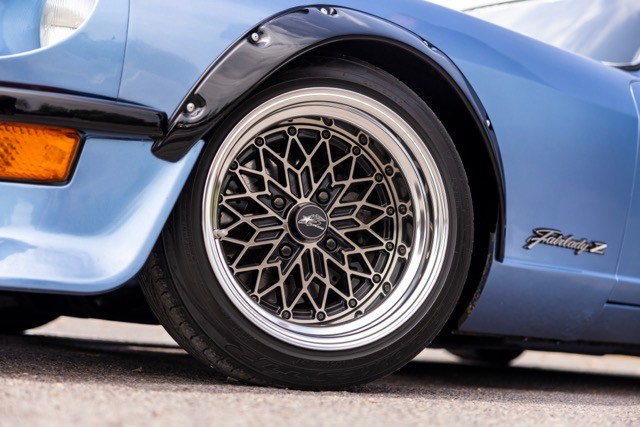
Star Road Glow Star wheels finish the look
The arches led Aaron further into the Star Road world.
After making contact with the Japanese specialist, he eventually travelled to Japan, built friendships within the scene and started collecting genuine parts rather than simply building a UK interpretation of a Japanese car.
The wheels are perhaps the clearest example.
Aaron’s car now runs Star Road Glow Stars, a wheel designed specifically around classic Japanese machinery. Star Road itself lists Glow Star as its wheel brand, while period coverage of the company’s builds confirms that the wheels were produced in collaboration with Work Wheels.
The rears measure a substantial 10J, with the fronts at 9J, and the aggressive negative offsets push the fitment neatly into those bolt-on arches.
The proportions are bang on. There are plenty of ways to make an S30 look expensive, but the difficult bit is making it look authentic. The Glow Stars, arches and ride height all feel like they belong together.
Even Fast Car has featured other Z builds on Glow Stars before, which gives some idea of how closely associated the wheel has become with this style of S30.
Genuine Japanese details matter
There are smaller details all over the car that tell the same story.
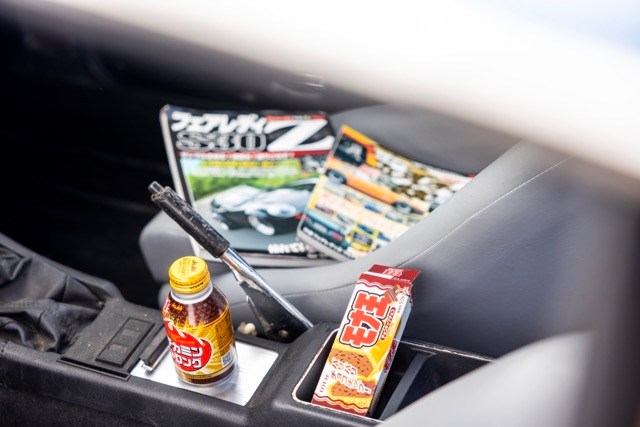
Aaron originally ran without wing mirrors because he liked the clean look, then tried replicas before eventually receiving a genuine set of period-style Nissan mirrors from a friend in Osaka. They arrived in their original boxes and were difficult enough to replace that he admits he was almost nervous about fitting them.
It would have been easier to keep them on a shelf.
But that isn’t really the point.
The car also wears small Japanese stickers and memorabilia connected to the people Aaron has met on his trips, while shows often see the boot filled with magazines and other pieces from his collection. None of it adds horsepower, but it adds context.
The car doesn’t simply imitate Japanese style. It reflects Aaron’s actual relationship with the Japanese car scene.
Zstory exhaust gives the L24 its voice
The exhaust follows the same philosophy.
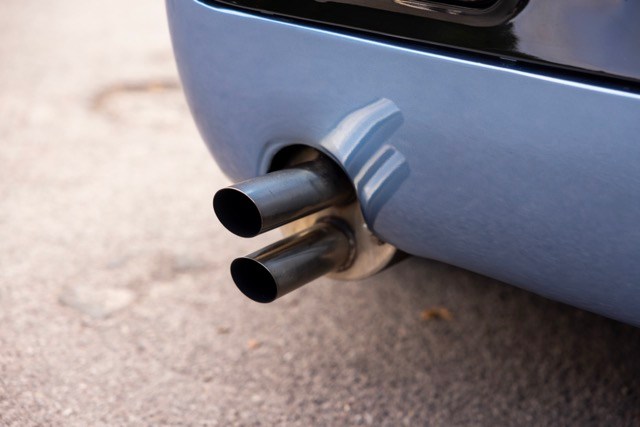
Aaron originally ran a tired old system that made the L24 sound surprisingly aggressive, but eventually replaced it with a setup from French Datsun specialist Zstory.
Zstory specialises in exhaust and performance components for the 240Z, 260Z and 280Z and offers headers, full systems and JDM-style twin-exit arrangements for L-series cars.
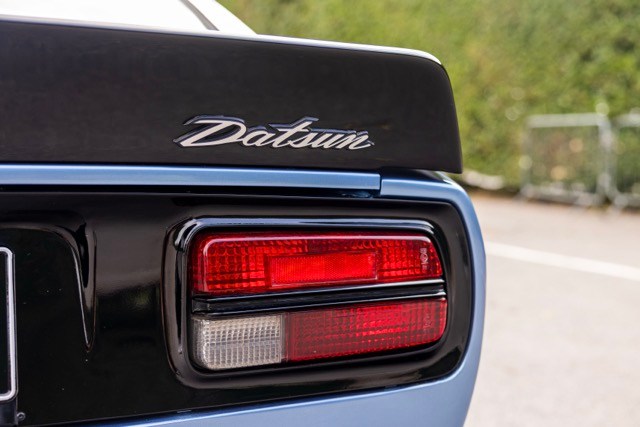
Aaron’s setup runs from the manifold into a distinctive stacked twin-pipe exit at the rear, giving the car the kind of old-school Japanese look he wanted.
It doesn’t sound like the tired system it replaced, but more importantly, the engine now breathes properly and the exhaust feels like another deliberate part of the build rather than an afterthought.
BC Racing suspension and road manners
Underneath, the Datsun sits on BC Racing coilovers, using an Extreme Low setup that allows Aaron to get the stance he wants while retaining adjustable damping.
The car might not appear absurdly low from every angle, but the subframe tells another story. At points it sits barely an inch from the floor, which Aaron discovered rather painfully when the centre catch from a set of electric gates took out one of his subframes.
That’s the danger of building a car this low and actually using it.
Still, Aaron wouldn’t change the overall character. He describes the Z as enormous fun on a country road, not because you need to drive it at ridiculous speed, but because everything feels alive. The steering, suspension and lack of electronic intervention mean the car communicates constantly.
Modern cars are objectively better at insulating you from bad roads.
The 240Z is better at reminding you that you’re driving.
Restoring the interior without losing its character
The cabin is still evolving.
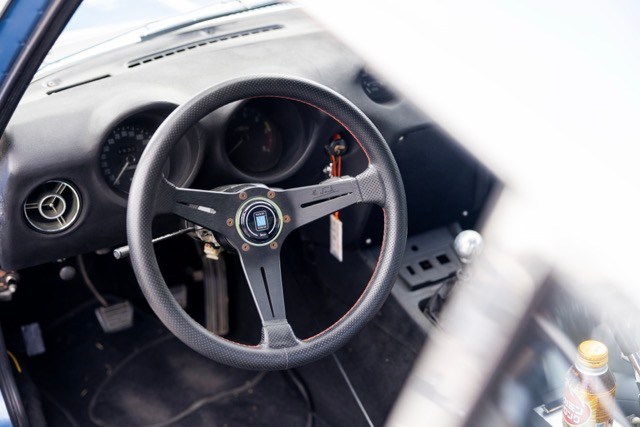
Rather than replace the original dashboard, Aaron repaired it because he wanted to retain the original part and the identity attached to it. That work has lasted well, although a few imperfections have started to reappear over the years and another interior refresh is now on the list.
A Nardi deep-corn steering wheel gives the driving position the old-school feel he wanted, while a Star Road aluminium gearknob adds another genuine Japanese detail.
The electrical system also became another learning exercise. Because the car arrived as a US-spec import, some of the lighting arrangements needed altering for use over here, so Aaron worked through the wiring and modified the rear-light functions accordingly.
The amusing part is that he still doesn’t regard himself as someone who knew how to work on cars when he started.
Technically, that’s true.
It just isn’t true anymore.
Why this modified Datsun 240Z matters
The easiest thing to admire about Aaron’s modified Datsun 240Z is the finished result. The stance is right, the colour suits the shape beautifully, and those Glow Stars give it exactly the Japanese flavour he was chasing.
But the best part of the car isn’t something you can photograph.
It’s the fact that Aaron bought a broken old Datsun without knowing how to change its oil and decided that, rather than paying someone else to solve every problem, he would use the car to teach himself.
Along the way he has stripped it, restored it, learned carburettors and wiring, rebuilt the engine twice, blown it up at Goodwood, travelled to Japan, made friends in the scene and collected genuine parts that now carry their own stories.
There are more powerful 240Zs. There are more expensive ones, and there are certainly cleaner ones.
But that almost misses the point.
A great project car should tell you something about the person who built it.
This one tells you almost everything.