
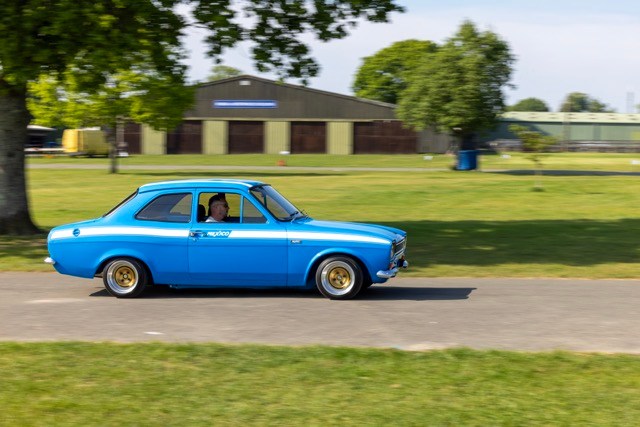
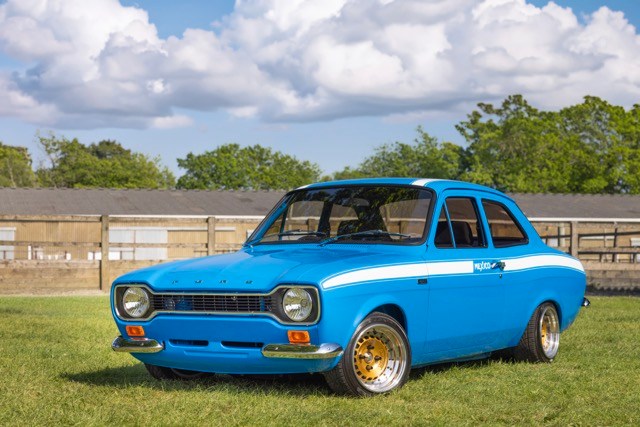
Some modified classics shout about every single change. Ricky’s Mk1 Escort does something much cleverer. At first glance, it looks like a beautifully finished old-school Escort with a strong Mexico influence, period-sized wheels and a spotless engine bay. Then you start looking closer.
There’s a 2.1-litre Zetec making 225bhp. A Quaife six-speed sequential gearbox. AP Racing brakes. A narrowed rear axle. Digital electronics. Heated seats. Power steering. And most of it was built at home.
That’s what makes this Mk1 Escort Zetec so good. It hasn’t lost the character of the original car in the chase for modern performance. Instead, it feels like a classic fast-road Escort built with the best bits now available.
A modern take on the classic Mk1 Escort Mexico
Ricky’s aim was simple enough: take the spirit of the modified Escorts people were building decades ago and update the recipe. Back then, a serious fast-road Mk1 might have ended up with a Pinto, upgraded brakes and whatever suspension parts were available at the time. Today, there are far more options.
Modern engines are easier to fit. Brake kits actually work. Sequential gearboxes exist in packages designed to fit old Ford transmission tunnels. Suspension geometry can be improved with parts bought straight off the shelf.
So rather than build a period replica, Ricky created his interpretation of what a modern fast-road Mexico-style Escort should be. And remarkably, the majority of it was done in his own garage. The build took around two to three years, with the interior and paint among the few major jobs handled elsewhere. Looking at the finished car, you’d never guess this was essentially a home build. The fit, finish and attention to detail are on another level.
Nitrous Blue gives the Mexico look a modern twist
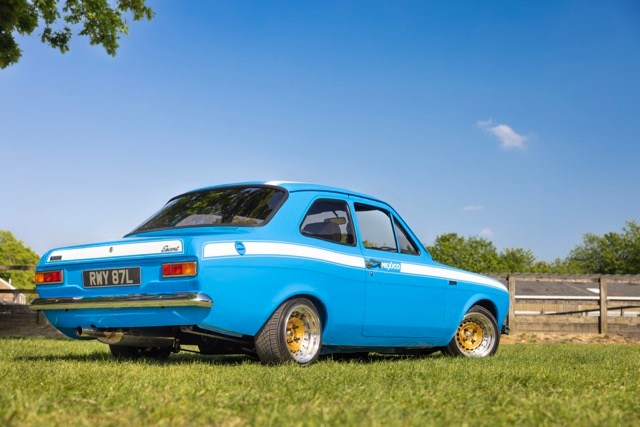
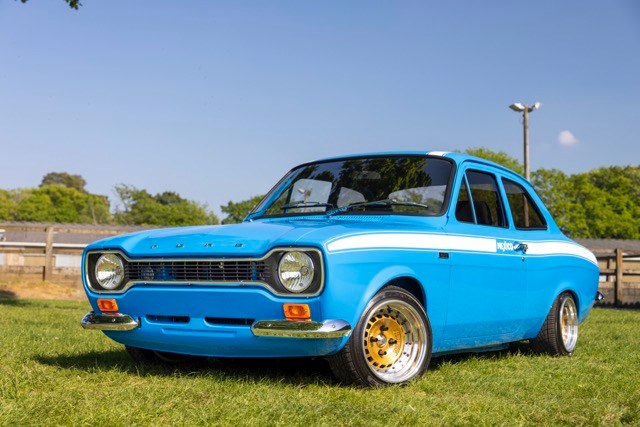
Even the paint tells the story of what this car is about. Ricky originally wanted a more traditional blue, but the painter went in a different direction and used Nitrous Blue, the colour famously associated with the Mk3 Focus RS. That could easily have looked too modern on a Mk1 Escort.
It doesn’t. In dull light, the colour still gives you that familiar classic-blue vibe. When the sun hits it, though, the metallic finish comes alive and makes the whole car pop. It’s a neat way of keeping the visual link to a classic Mexico while introducing something much newer. The white detailing helps too.
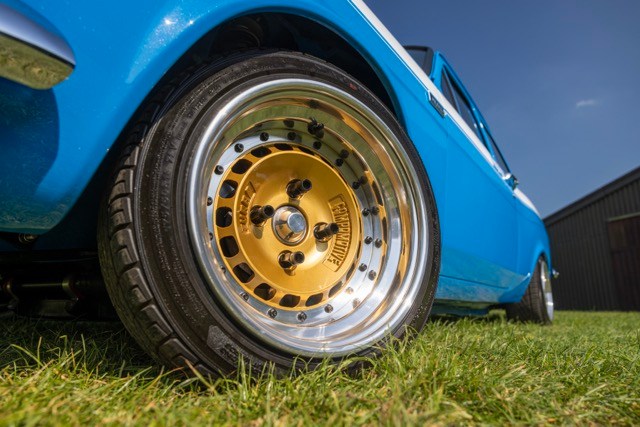
Then there are the wheels. The Escort sits on chunky 13-inch Compomotives, exactly the sort of wheel size this shape needs. Going bigger might have made fitting larger brakes easier, but it would also have changed the whole character of the car. Instead, Ricky stuck with 13s and engineered everything else around them. That decision sums up the build nicely. Modern engineering, old-school proportions.
Inside the 2.1-litre Mk1 Escort Zetec
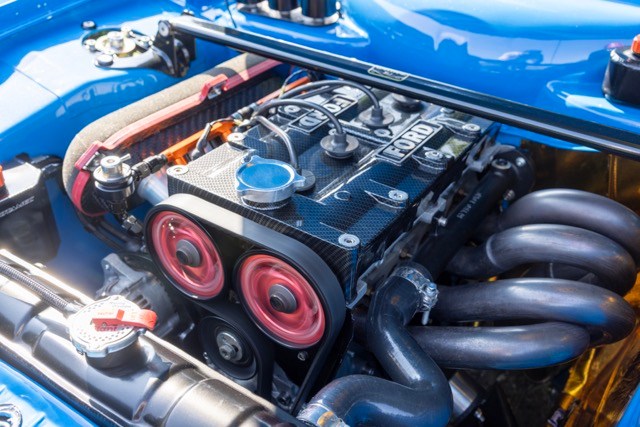
Under the bonnet is where things get properly interesting. What initially looks like it could be some sort of old-school competition Ford engine is actually a 2.1-litre Zetec. The bottom end is far from standard, with an Arrow crankshaft and uprated rods and pistons forming the core of the build. The cylinder head has also been worked, making this a properly developed naturally aspirated package rather than a stock Zetec with a set of throttle bodies thrown at it.
Speaking of which, induction comes via 45mm throttle bodies. Engine management is handled by an Emerald K6 ECU, with the final mapping carried out by AP Racing Engines in Mansfield. The result is 225bhp. That figure might not sound outrageous in an era of 500bhp hot hatches and four-figure turbo builds, but context matters. This is an old Escort weighing well under a tonne without Ricky aboard.
Corner-weighted with the driver in it, the car came in at around 980kg. That means 225bhp is more than enough to make this thing properly lively. And because it’s naturally aspirated, you get throttle response, induction noise and revs rather than waiting for a huge turbo to wake up. For a fast-road Mk1, that arguably suits the character far better.
Making a modern engine work in a Mk1 Escort
The clever part is how straightforward this sort of conversion can now be. A few decades ago, fitting a modern engine into a classic Escort could mean endless one-off fabrication and trial-and-error. Today, companies supporting the classic Ford scene have already solved many of those problems. Ricky has used a collection of off-the-shelf conversion parts rather than reinventing everything.
The standard-style crossmember remains, with altered rack positioning and other changes helping create the required space. The original anti-roll-bar arrangement has also made way for compression struts. There’s a Group 4-style front-end setup in there too, adding to the competition-inspired hardware underneath. That availability of good parts is one reason Mk1 and Mk2 Escorts remain such brilliant platforms. You can still build one exactly how you want it without having to fabricate every single bracket from scratch.
Suspension, brakes and rear axle
The suspension has evolved over the build too. Ricky originally used Bilstein components, but the front now runs Gaz Gold suspension, helping get the car sitting where he wanted while maintaining the fast-road intent. Again, it’s all available off the shelf.
The real challenge comes with brakes. Keeping 13-inch wheels massively restricts the space available inside the rim, so you can’t simply throw on the biggest discs and calipers you can find. Ricky’s solution uses AP Racing four-pots at the front, with Wilwood brakes at the rear. That gives the car proper stopping power while retaining those crucial period-size wheels.
There’s also a bias pedal box with hydraulic clutch operation, moving the controls another step towards proper competition-car hardware. At the rear, things become even more interesting. The English axle had to be narrowed because those wide 13-inch wheels simply wouldn’t sit beneath the standard arches correctly.
Ricky brought the axle down to a little over Anglia width and paired it with shortened/customised shafts. Inside sits a 3J Driveline NXG limited-slip differential, giving the Escort the traction hardware it needs to make proper use of the Zetec. This isn’t stance for stance’s sake. The hardware underneath backs up the look.
Quaife sequential gearbox changes the character completely
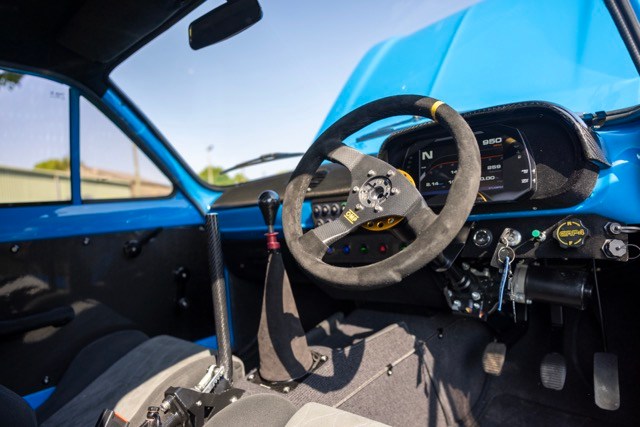
Then we get to one of our favourite parts of the car. That innocent-looking carbon gearknob isn’t attached to a normal Type 9. It controls a Quaife QBE60G six-speed sequential gearbox.
Quaife describes the QBE60G as a heavy-duty six-speed sequential designed as a direct replacement for Ford Type 9 installations, with enough capacity for serious power while still fitting Mk1 and Mk2 Escorts without major transmission-tunnel surgery. That makes it almost ridiculously appropriate here.
You’ve got a fully trimmed classic Escort, complete with beautiful interior and creature comforts, but sitting in the middle is a proper sequential gearbox. It completely changes the personality of the car. This might look like a show build, but there’s some very serious driving hardware hiding underneath all that polish.
A custom interior with old-school roots
Open the door and the quality continues. Carbon appears throughout the cabin, but it hasn’t simply been plastered everywhere for effect. The dash top and parcel shelf required remanufactured original-style pieces to be used as patterns before carbon versions could be produced. Other panels were available off the shelf.
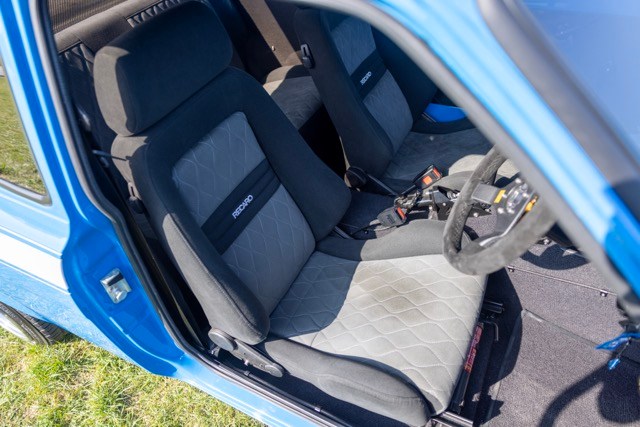
The finished result gives the cabin a competition edge while still retaining the overall shape and feel of a Mk1 Escort interior. The seats are Recaro LX-series items, retrimmed with a diamond-stitched pattern that adds a much more luxurious feel. Then comes the modern tech.
A digital display sits ahead of the driver, while CAN-based switch controls handle various functions. AEM’s current CD-series digital dashes support CAN integration and motorsport data display, which is exactly the sort of technology that makes sense in a build like this.
Ricky had originally intended to move further towards a full PDM-controlled electrical system, but parts availability during the build meant that element was postponed. The entire car has still been rewired around the new hardware.
Heated seats in a Mk1 Escort? Absolutely
Then things get unexpectedly civilised. Electric power steering? Yep. Heated windscreen? Also yes. Heated seats? Obviously.
It’s the heated seats that really give away how much thought has gone into making this a genuinely usable road car rather than a stripped-out competition replica. You can have the sequential gearbox and the fly-off handbrake when you want to play. But you can also have a warm backside on a miserable British morning. That’s progress.
And really, that is what this whole project is about. It retains the essence of the early Escort while quietly fixing some of the compromises that came with driving one.
A boot build as detailed as the engine bay
Plenty of show builds fall apart when you open the boot. Everything looks spectacular outside, the engine bay is polished to within an inch of its life, then you lift the rear lid and discover a mess of wiring, exposed hardware and whatever happened to be lying around when the car was assembled. Not here.
Ricky has treated the boot with the same level of detail as the rest of the Escort. A Group 4 Fabrications fuel tank sits at the centre of the setup, with the injection system, pumps and filter all neatly arranged around it. The wiring is labelled properly. The fittings match. Even the bolts, washers and straps have been selected or finished so nothing looks out of place. Black fittings replace the usual random mix of red and blue hardware, helping everything tie into the overall colour scheme. It’s wonderfully obsessive. And we mean that as a compliment.
The original-style external fuel filler has even been retained as a dummy, keeping the exterior looking correct despite the modern fuel arrangement hiding underneath. Again, classic appearance. Modern function.

Why this Mk1 Escort Zetec works so well
There’s a reason this Escort has picked up awards and drawn crowds wherever Ricky takes it. It isn’t simply because everything is shiny. It works because the whole car follows one clear idea. Take what enthusiasts loved about modified Mk1 Escorts in the first place, then use modern parts to improve the performance, reliability and usability without destroying the original character.
That sounds simple. Getting it right is much harder. Too much modernisation and a classic starts feeling like a new car wearing an old shell. Go too traditional and you miss the opportunity to make it genuinely better to drive.
Ricky’s Mk1 Escort Zetec lands right in the middle. It still sits on 13s. Still looks like a Mexico-inspired Mk1. And still feels unmistakably old-school. But underneath that familiar shape is a 225bhp Zetec, sequential gearbox, proper differential, serious brakes, modern electronics and enough comfort to make actually using it a pleasure.
And the fact most of it came together in a home garage? That might be the most impressive bit of all.